I Can Never Watch Grave of the Butterfly Again
| Grave of the Fireflies | |
|---|---|
 Theatrical release affiche | |
| Japanese | 火垂るの墓 |
| Hepburn | Hotaru no Haka |
| Directed by | Isao Takahata |
| Screenplay by | Isao Takahata |
| Based on | "Grave of the Fireflies" past Akiyuki Nosaka |
| Produced by | Toru Hara |
| Starring |
|
| Cinematography | Nobuo Koyama |
| Edited past | Takeshi Seyama |
| Music by | Michio Mamiya |
| Product | Studio Ghibli |
| Distributed by | Toho |
| Release appointment |
|
| Running fourth dimension | 89 minutes[1] |
| Country | Nippon |
| Language | Japanese |
| Box office |
|
Grave of the Fireflies (Japanese: 火垂るの墓, Hepburn: Hotaru no Haka ) is a 1988 Japanese animated state of war tragedy film[4] [5] based on the 1967 semi-autobiographical curt story of the same name by Akiyuki Nosaka. It was written and directed by Isao Takahata, and blithe by Studio Ghibli for the story's publisher Shinchosha Publishing (making it the only Studio Ghibli film under Tokuma Shoten ownership that had no involvement from them).[6] The movie stars Tsutomu Tatsumi, Ayano Shiraishi, Yoshiko Shinohara and Akemi Yamaguchi. Prepare in the city of Kobe, Japan, the film tells the story of two siblings, Seita and Setsuko, and their desperate struggle to survive during the final months of the Second World War. Grave of the Fireflies received critical acclaim and has been ranked as one of the greatest state of war films of all time and has been recognized as a major work of Japanese animation.[seven] [eight]
Plot [edit]

Akitani Swimming: The site where Seita and Setsuko lived alone together
In 1945, teenager Seita and his younger sister Setsuko's house is destroyed in a firebombing along with nearly of Kobe. They escape unharmed, simply their female parent dies from severe burns. Seita conceals their mother'southward decease from Setsuko in an attempt to keep her happy, which she later learns of despite Seita's efforts. Seita and Setsuko move in with a distant aunt, and Seita retrieves supplies he buried before the bombing and gives everything to his aunt, save for a can of Sakuma drops. The aunt convinces Seita to sell his mother's silk kimono for rice as rations compress and the number of refugees in the house grows. Seita uses some of his mother's money in the bank to buy supplies, simply eventually, the aunt becomes resentful of the children, deeming them unworthy of earning her food.
Seita and Setsuko decide to get out the aunt's domicile afterward excessive insults, and they move into an abandoned bomb shelter. They release fireflies into the shelter for light. The next 24-hour interval, Setsuko is horrified to detect that the insects have died. She buries them in a grave, asking why they and her female parent had to die. As they run out of rice, Seita steals from farmers and loots homes during air raids, for which he is beaten and sent to the law. The officeholder realizes Seita is stealing due to hunger and releases him. When Setsuko falls ill, a dr. explains that she is suffering from malnutrition. Desperate, Seita withdraws the last of the money in their mother's bank account. Afterwards doing so, he becomes distraught when he learns that Nihon has surrendered, and that his father, an Imperial Japanese Navy captain, is most likely dead, as most of Nihon'due south navy has been sunk. Seita returns to Setsuko with food, only finds her dying. She later dies as Seita finishes preparing the food. Seita cremates Setsuko's body and her stuffed doll in a harbinger catafalque. He carries her ashes in the candy tin along with his begetter's photograph.
Shortly later the end of World State of war 2, Seita dies of starvation at a Sannomiya train station surrounded by other malnourished people. A janitor is tasked with removing the bodies before the arrival of the Americans. The janitor sorts through Seita'due south possessions and finds the processed can, which he throws into a field. Setsuko'south ashes spread out, and her spirit springs from the can and is joined by Seita's spirit and a cloud of fireflies. They lath a ghostly railroad train and, throughout the journeying, await back at the events leading to Seita'south death. Their spirits after arrive at their destination, healthy and happy. Surrounded by fireflies, they rest on a hilltop bench overlooking present-day Kobe.
Cast [edit]
| Graphic symbol | Japanese voice actor | English vocalisation actor | |
|---|---|---|---|
| Skypilot Entertainment/CPM (1998) | Toho/Seraphim/Sentai (2012) | ||
| Seita Yokokawa ( 横川 清太 ) | Tsutomu Tatsumi | J. Robert Spencer | Adam Gibbs |
| Setsuko Yokokawa ( 横川 節子 ) | Ayano Shiraishi | Corinne Orr | Emily Neves |
| Mrs. Yokokawa ( 横川 さん ) | Yoshiko Shinohara | Veronica Taylor | Shelley Calene-Black |
| Seita and Setsuko's aunt | Akemi Yamaguchi | Amy Jones | Marcy Bannor |
| Seita and Setsuko's cousin | Kazumi Nozaki | Shannon Conley | |
| Farmer | Dan Green | ||
| Doctor | Michio Denpō | Crispin Freeman | |
| Former man | |||
| Railroad train station worker | Teruhisa Harita Michio Denpō | Andrew Honey | |
Production [edit]
Development [edit]
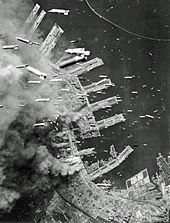
Incendiary bombs existence dropped onto Kobe, the setting of the film
Grave of the Fireflies author Akiyuki Nosaka said that many offers had been made to make a alive-activeness film adaptation of his short story.[ix] Nosaka argued that "it was impossible to create the barren, scorched globe that's to be the backdrop of the story".[9] He also argued that contemporary children would non be able to convincingly play the characters. Nosaka expressed surprise when an animated version was offered.[9] After seeing the storyboards, Nosaka ended that it was not possible for such a story to have been fabricated in any method other than animation and expressed surprise in how accurately the rice paddies and townscape were depicted.[9]
Isao Takahata said that he was compelled to film the short story after seeing how the main graphic symbol, Seita, "was a unique wartime 9th grader".[10] Takahata explained that whatever wartime story, whether animated or non animated, "tends to be moving and tear-jerking", and that young people develop an "inferiority complex" where they perceive people in wartime eras as being more noble and more able than they are, and therefore the audience believes that the story has nothing to exercise with them. Takahata argued that he wanted to dispel this mindset.[ix] When Nosaka asked if the pic characters were "having fun", Takahata answered that he conspicuously depicted Seita and Setsuko had "substantial" days and that they were "enjoying their days".[11] Takahata said that Setsuko was even more difficult to animate than Seita, and that he had never before depicted a girl younger than v.[9] Takahata said that "In that respect, when yous make the book into a picture show, Setsuko becomes a tangible person", and that 4-year-olds often become more assertive and self-centered, and endeavor to get their ain ways during that historic period. He explained that while one could "have a scene where Seita can't stand that anymore", it is "hard to incorporate into a story".[12] Takahata explained that the picture is from Seita'south point of view, "and even objective passages are filtered through his feelings".[11]
Takahata said that he had considered using not-traditional animation methods, but considering "the schedule was planned and the motion-picture show'southward release date set, and the staff assembled, it was apparent at that place was no room for such a trial-and-error arroyo".[11] He farther remarked that he had difficulty animative the scenery since, in Japanese animation, one is "not immune" to describe Japan in a realistic style.[9] Animators oft traveled to foreign countries to do inquiry on how to depict them, but such research had not been done before for a Japanese setting.[9] While animating the film, Takahata also created several different cuts of the scene in which Seita cremates Setsuko's trunk. Takahata spent a lot of time on this scene, trying to create the perfect iteration of information technology. Each of these cuts remained unfinished and unused in the end.[13]
Most of the illustration outlines in the picture show are in brown, instead of the customary black. Blackness outlines were only used when information technology was absolutely necessary. Color coordinator Michiyo Yasuda said this was done to give the motion picture a softer feel. Yasuda said that this technique had never been used in an anime before Grave of the Fireflies, "and it was done on a challenge".[9] Yasuda explained that brown is more than hard to use than black because it does not contrast as well as black.[9]
Music [edit]
The flick score was composed by Michio Mamiya. Along with the original soundtrack, the song "Dwelling house Sweetness Dwelling house", performed by coloratura soprano Amelita Galli-Curci, was included.[14] Dialogue of the film is office of the soundtrack, the music and dialogue are not separated in any manner.[15] Mamiya is as well a music specialist in baroque and classical music.
During an interview about his music, Mamiya stated that he creates his music to encourage peace.[sixteen] The songs in Grave of the Fireflies as well as other pieces by Michio Mamiya such as Serenade No.3 "Germ", limited this theme.[16]
Original Soundtrack[xv] [edit]
| No. | Title | Length | No. | Title | Length | No. | Title | Length |
|---|---|---|---|---|---|---|---|---|
| 1 | 節子と清太~メインタイトル (Setsuko and Seita - Main Title) | ii:57 | 7 | 波打際 (The Embankment) | one:37 | 13 | ほたる (Fireflies) | 4:12 |
| 2 | 焼野原 (The Burnt-out Area) | 6:51 | 8 | 日傘 (The Parasol) | 2:26 | 14 | ほたるの墓 (Grave of the Fireflies) | 1:46 |
| 3 | 母の死 (Mother'due south Expiry) | 6:34 | 9 | 桜の下 (Under the Ruddy Blossoms) | 1:31 | fifteen | 夕焼け (Sunset Colors) | 0:53 |
| 4 | 初夏 (Early Summertime) | 3:14 | 10 | ドロップス (Drops) | 2:13 | 16 | 修羅 (Scene of Carnage) | iii:08 |
| 5 | 池のほとり (At the Shore of the Swimming) | 2:21 | xi | 引越し (Moving) | ii:17 | 17 | 悲歌 (Elegy / Vocal of Sorrow) | 3:12 |
| vi | 海へ (To the Ocean) | 1:37 | 12 | 兄妹 (Older Brother, Younger Sis) | 2:xv | 18 | ふたり~エンドタイトル [Two (People) - End Championship] | 8:52 |
Themes and assay [edit]
Some critics in the West take viewed Grave of the Fireflies equally an anti-state of war film due to the graphic and emotional depiction of the pernicious repercussions of state of war on a gild, and the individuals therein. The film focuses its attention almost entirely on the personal tragedies that war gives rise to, rather than seeking to glamorize it as a heroic struggle between competing nations. Information technology emphasizes that war is society'southward failure to perform its nigh important duty: to protect its own people.[17]
However, managing director Takahata repeatedly denied that the film was an anti-war film. In his ain words, information technology "is not at all an anti-state of war anime and contains absolutely no such message". Instead, Takahata had intended to convey an image of the blood brother and sister living a failed life due to isolation from guild and invoke sympathy particularly in people in their teens and twenties.[18] [19]
Since the film gives petty context to the state of war, Takahata feared a politico could just as easily claim fighting is needed to avoid such tragedies. In full general, he was skeptical that depictions of suffering in similar works, such as Barefoot Gen, actually prevent aggression. The director was all the same an anti-state of war advocate, a staunch supporter of Article 9 of the Japanese Constitution, and has openly criticized Japan'southward penchant for conformity, allowing them to be rallied confronting other nations. He expressed despair and feet whenever the youth are told to fall in line, a reminder that the country at its core has not changed.[20]
Release [edit]
Theatrical [edit]
The film was released on sixteen April 1988, over 20 years from the publication of the short story.[12]
The initial Japanese theatrical release was accompanied past Hayao Miyazaki'due south light-hearted My Neighbor Totoro equally a double characteristic. While the ii films were marketed toward children and their parents, the starkly tragic nature of Grave of the Fireflies turned away many audiences. However, Totoro merchandise, peculiarly the blimp animals of Totoro and Catbus, sold extremely well afterwards the film and made overall profits for the company to the extent that it stabilized subsequent productions of Studio Ghibli.
Grave of the Fireflies is the but theatrical Studio Ghibli characteristic film prior to From Upwards on Poppy Hill to which Disney never had North American distribution rights, since it was non produced by Ghibli for parent company Tokuma Shoten only for Shinchosha, the publisher of the original short story (although Disney has the Japanese habitation video distribution rights themselves, thus replacing the picture show'due south original Japanese home video benefactor, Bandai Visual).[21] Information technology was one of the last Studio Ghibli films to get an English language-linguistic communication premiere by GKIDS.[22]
Habitation media [edit]
Grave of the Fireflies was released in Japan on VHS past Buena Vista Home Entertainment under the Ghibli ga Ippai Drove on 7 Baronial 1998. On 29 July 2005, a DVD release was distributed through Warner Habitation Video. Walt Disney Studios Japan released the complete collector's edition DVD on 6 August 2008. WDSJ released the picture on Blu-ray twice on eighteen July 2012: one every bit a unmarried release, and 1 in a two-moving-picture show set with My Neighbor Totoro (even though Disney never currently owns the North American but Japanese rights as mentioned).
It was released on VHS in Northward America past Central Park Media in a subtitled form on 2 June 1993.[23] They subsequently released the movie with an English dub on VHS on i September 1998 (the day Disney released Kiki's Delivery Service) and an all-Regions DVD (which besides included the original Japanese with English subtitles) on seven October 1998. On 8 Oct 2002, it was later released on a two-disc DVD gear up, which once again included both the English dub and the original Japanese with English language subtitles as well as the film's storyboards with the 2d disc containing a retrospective on the author of the original book, an interview with the managing director, and an interview with critic Roger Ebert, who felt the picture was ane of the greatest of all time.[24] It was released past Cardinal Park Media ane last time on vii December 2004. Following the May 2009 defalcation and liquidation of Key Park Media,[25] ADV Films caused the rights and re-released it on DVD on 7 July 2009.[26] Post-obit the 1 September 2009 shutdown and re-branding of ADV,[27] their successor, Sentai Filmworks, rescued the film and released a remastered DVD on six March 2012, and planned to release the picture on digital outlets.[28] [29] A Blu-ray edition was released on xx Nov 2012, featuring an all-new English dub produced by Seraphim Digital.[30]
StudioCanal released a Blu-ray in the U.k. on 1 July 2013, followed past Kiki'due south Commitment Service on the aforementioned format.[31] Information technology was the U.k.'southward tenth almanac acknowledged foreign language motion picture on home video in 2019 (below vii other Japanese films, including 6 Hayao Miyazaki anime films).[32] Madman Entertainment released the film in Australia and New Zealand.
Reception [edit]
The flick was modestly successful at the Japanese box office,[33] where it grossed ¥i.7 billion.[2] Equally part of the Studio Ghibli Fest 2018, the pic had a express theatrical release in the United States, grossing $516,962.[3]
The Ghibli ga Ippai Collection abode video release of Grave of the Fireflies sold 400,000 copies in Japan.[34] At a price of at least ¥4,935,[35] this is equivalent to at least ¥1.974 billion in sales revenue.
The picture received universal critical acclaim. Roger Ebert of the Chicago Sun-Times considered it to exist one of the best and most powerful war films and, in 2000, included it on his list of nifty films.[24] The picture show review aggregator website Rotten Tomatoes reported a 100% approval rating based on xl reviews with an average rating of 9.30/10. The website'south critical consensus reads: "An achingly distressing anti-war flick, Grave of the Fireflies is 1 of Studio Ghibli's most profoundly cute, haunting works."[36]
Filmmaker Akira Kurosawa praised the film and considered information technology his favourite Ghibli production. He wrote a letter of praise to Hayao Miyazaki, mistakenly believing he directed Grave of the Fireflies. Miyazaki himself praised the movie every bit Takahata's masterpiece, but criticized Seita for not behaving how he believes the son of a navy lieutenant should conduct.[37]
The flick ranked number 12 on Total Picture 'southward 50 greatest animated films.[38] It was also ranked at number 10 in Time Out 's "The fifty greatest World War II movies" list.[39] Empire magazine ranked the flick at number half dozen in its list of "The Peak 10 Depressing Movies".[40] The film ranked number xix on Magician's Anime Magazine on their "Tiptop 50 Anime released in Due north America".[41] The Daily Star, ranking the moving picture 4th on its list of greatest short story adaptations, wrote that "There is both much and lilliputian to say well-nigh the film. Information technology is simply an experience—a trip through the lone boroughs of humanity that the globe collectively looked, and even so looks, away from".[42] Theron Martin of Anime News Network said that, in terms of the original U.S. Manga Corps dub, while the other voices were "perfectly acceptable", "Setsuko merely doesn't sound quite convincing as a four-year-old in English. That, unfortunately, is a large negative, since a good chunk of the pathos the movie delivers is at to the lowest degree partly dependent on that performance".[28]
On 25 December 2016, Toei Company made a Twitter post that read "Why did Kiriya have to die then soon?" ( なんできりやすぐ死んでしまうん , Nande Kiriya sugu shinde shimaun? ) in society to promote an episode of Kamen Rider Ex-Aid. The hashtag became popular, merely Toei deleted the tweet after receiving complaints that referencing the Grave of the Fireflies line "Why practise fireflies die so soon?" ( なんで蛍すぐ死んでしまうん , Nande hotaru sugu shinde shimaun ) was in poor taste.[43] Earlier that, the ranking website Goo'south readers voted the film's ending the number 1 most miserable of all anime films.[44]
On June 2018, Us Today ranked 1st on the 100 best animated movies of all time.[45]
Public reactions [edit]
Later the international release, it has been noted that different audiences have interpreted the picture show differently due to differences in culture. For instance, when the film was watched by a Japanese audience, Seita'south decision to not come back to his aunt was seen as an understandable conclusion, as they were able to understand how Seita had been raised to value pride in himself and his country. Simply American and Australian audiences were more than likely to perceive the decision equally unwise, due to the cultural differences in social club to try to save his sister and himself.[46] [47]
Accolades [edit]
| Year | Award | Category | Recipient | Issue |
|---|---|---|---|---|
| 1989 | Bluish Ribbon Awards | Special Honor | Isao Takahata | Won |
| 1994 | Chicago International Children'south Moving-picture show Festival | Animation Jury Honour | Won | |
| Rights of the Kid Laurels | Won |
Derivative works [edit]
Planned follow-up [edit]
Following the success of Grave of the Fireflies, Takahata drew upwards an outline for a follow-up film, based on like themes merely fix in 1939 at the start of the second World War. This film was called Edge 1939, based on the novel The Border by Shin Shikata, and would take told the story of a Japanese teenager from colonial Seoul joining an anti-Japanese resistance group in Mongolia. The film was intended equally an indictment of Japanese imperialist sentiment, which is briefly touched upon in Grave of the Fireflies. Although Takahata finished a full outline (which is republished in his book Thoughts While Making Movies), the film was canceled before production could start due to the 1989 Tiananmen Square protests. Public opinion in Japan had turned against People's republic of china, and Ghibli's distributor felt a film partly ready there was as well risky.[48]
2005 live-action version [edit]
NTV in Japan produced a live-activeness Television receiver drama of Grave of the Fireflies, in commemoration of the 60th anniversary of the end of World War Two. The drama aired on 1 November 2005. Like the anime, the live-action version of Grave of the Fireflies focuses on two siblings struggling to survive the last months of the war in Kobe, Nippon. Dissimilar the animated version, information technology tells the story from the point of view of their cousin (the aunt's girl) and deals with the issue of how the state of war-time environment could modify a kind lady into a hard-hearted adult female. It stars Nanako Matsushima as the aunt, too as Mao Inoue as their cousin.
2008 live-activeness version [edit]
A different live-activity version was released in Japan on v July 2008, Reo Yoshitake every bit Seita, Rina Hatakeyama as Setsuko, Keiko Matsuzaka as the aunt, and Seiko Matsuda equally the children's female parent. Similar the anime, this live-action version of Grave of the Fireflies focuses on two siblings struggling to survive the final months of the war in Kobe, Japan.[49]
Encounter also [edit]
- Air raids against Nihon during World State of war II
- Evacuations of civilians in Japan during World War 2
- Barefoot Gen, a manga series set in the aftermath of the atomic bombing of Hiroshima.
- Fragile Dreams: Farewell Ruins of the Moon, a video game with similarities to the film.[50]
References [edit]
- ^ "GRAVE OF THE FIREFLIES (12A)". British Board of Film Classification. 17 May 2013. Archived from the original on 14 August 2015. Retrieved 17 May 2013.
- ^ a b 超意外な結果!?ジブリ映画の興行収入ランキング. シネマズ PLUS (Cinemas PLUS) (in Japanese). 25 June 2016. Archived from the original on nine July 2019. Retrieved fifteen February 2019.
- ^ a b "Grave of the Fireflies – Studio Ghibli Fest 2018 (2018)". Box Office Mojo . Retrieved 17 Feb 2019.
- ^ Camp, Brian; Davis, Julie (August 2007). Anime Classics Zettai!. ISBN9781611725193.
- ^ Steiff, Josef; Tamplin, Tristan (10 Apr 2010). Anime and Philosophy. ISBN9780812697131.
- ^ "Hotaru no haka". The Big Cartoon DataBase . Retrieved 13 May 2012.
- ^ Ebert, Roger. "Grave of the Fireflies picture show review (1988) | Roger Ebert". rogerebert.com/ . Retrieved 24 November 2020.
- ^ "The 50 best World War II movies". Time Out London . Retrieved 24 November 2020.
- ^ a b c d eastward f g h i j "The Animerica Interview: Takahata and Nosaka: Two Grave Voices in Animation". Animerica. two (xi): 8. 1994. Archived from the original on 4 July 2018. Retrieved 4 July 2018. Translated by Animerica from: Takahata, Isao (1991). 映画を作りながら考えたこと [Things I Thought While Making Movies]. Tokuma Shoten. ISBN9784195546390. Originally published in Animage, June 1987. This is a translation of a 1987 chat between Takahata and Akiyuki Nosaka.
- ^ "The Animerica Interview: Takahata and Nosaka: Two Grave Voices in Blitheness". Animerica. 2 (11): 7. 1994. Archived from the original on iv July 2018. Retrieved 4 July 2018.
- ^ a b c "The Animerica Interview: Takahata and Nosaka: Two Grave Voices in Animation". Animerica. 2 (xi): 10. 1994. Archived from the original on 4 July 2018. Retrieved 4 July 2018.
- ^ a b "The Animerica Interview: Takahata and Nosaka: Ii Grave Voices in Blitheness". Animerica. 2 (xi): 9. 1994. Archived from the original on 4 July 2018. Retrieved iv July 2018.
- ^ "Interview: Studio Ghibli Production Coordinator Hirokatsu Kihara". Anime News Network . Retrieved 2 March 2022.
- ^ "Anime Classical: The All-time Operatic Moment in Anime Was Also Its Saddest". Altorito. Archived from the original on 29 November 2014. Retrieved 23 November 2014.
- ^ a b "Grave of the Fireflies (Original Soundtrack) - GhibliWiki". world wide web.nausicaa.net . Retrieved five February 2022.
- ^ a b "Michio Mamiya interview transcript - from Minnesota Public Radio Music". music.minnesota.publicradio.org . Retrieved 4 February 2022.
- ^ Etherington, Daniel. "Grave of the Fireflies (Hotaru no haka)". Film4. Channel Four Television Corporation. Archived from the original on 22 March 2013. Retrieved 23 November 2012.
- ^ Interview published on May 1988 edition of Animage
- ^ Takahata, Isao (1991). 映画を作りながら考えたこと [Things I Thought While Making Movies] (in Japanese). Tokuma Shoten. p. 471. ISBN9784195546390.
- ^ Takahata, Isao (i January 2015). "時代の正体〈47〉過ち繰り返さぬために" [The Truth Behind History <47> To Prevent Repeating Mistakes]. Kanagawa Shimbun. Archived from the original on 6 March 2016. Retrieved 29 Feb 2016.
- ^ "The Disney-Tokuma Deal". Nausicaa.internet. Team Ghiblink. 10 September 2003. Archived from the original on 29 December 2010. Retrieved 5 January 2011.
- ^ Social club, Guy (twenty November 2012). "GKIDS extends its Studio Ghibli alliance to 'Grave of the Fireflies'". Hitfix. Uproxx. Archived from the original on 4 July 2018. Retrieved 6 May 2017.
- ^ "Animerica". Animerica : Anime & Manga Monthly. one (4): 18. June 1993. ISSN 1067-0831.
- ^ a b Ebert, Roger (xix March 2000). "Grave of the Fireflies". RogerEbert.com. Ebert Digital LLC. Archived from the original on 8 May 2013. Retrieved 22 November 2012.
- ^ Loo, Egan (28 Apr 2009). "Cardinal Park Media Files for Chapter seven Bankruptcy". Anime News Network. Archived from the original on 4 July 2018. Retrieved 3 July 2018.
- ^ Loo, Egan (5 May 2009). "ADV Adds Grave of the Fireflies, Now and And then, Here and There". Anime News Network. Archived from the original on 29 November 2012. Retrieved 24 November 2012.
- ^ Loo, Egan (ane September 2009). "ADV Films Shuts Down, Transfers Assets to Other Companies". Anime News Network. Archived from the original on 3 October 2009. Retrieved 25 January 2010.
- ^ a b Martin, Theron (five March 2012). "Review: Grave of the Fireflies: DVD – Remastered Edition". Anime News Network. Archived from the original on seven Nov 2012. Retrieved 22 November 2012.
- ^ "Sentai Filmworks Adds Grave of the Fireflies". Anime News Network. 1 December 2011. Archived from the original on 2 December 2011. Retrieved 1 December 2011.
- ^ "Grave of the Fireflies [Blu-ray] (2012)". Amazon . Retrieved 22 November 2012.
- ^ Osmond, Andrew (29 June 2013). "Kiki'south Delivery Service and Grave of the Fireflies Double Play Released Monday (Updated)". Anime News Network. Archived from the original on 4 February 2015. Retrieved 27 December 2014.
- ^ BFI Statistical Yearbook 2020. United Kingdom: British Film Institute (BFI). 2020. p. 94. Retrieved 26 Apr 2022.
- ^ Runyon, Christopher (20 Nov 2013). "The Studio Ghibli Retrospective: 'Grave of the Fireflies'". Movie Mezzanine. Archived from the original on 15 November 2014. Retrieved 22 November 2014.
- ^ 日経BP社技術研究部 『進化するアニメ・ビジネス―世界に羽ばたく日本のアニメとキャラクター』日経BP社、2000年、47頁。ISBN 4822225542
- ^ "ジブリがいっぱい COLLECTION". クラウン徳間ミュージックショップ (in Japanese). Retrieved 25 February 2020.
- ^ "Hotaru no haka (Grave of the Fireflies) (1988)". Rotten Tomatoes. Archived from the original on 27 November 2012. Retrieved 3 July 2018.
- ^ Wit, Alex Dudok de (8 April 2021). Grave of the Fireflies. Bloomsbury Publishing. p. 103. ISBN978-1-83871-925-8 . Retrieved 31 March 2022.
- ^ Kinnear, Simon (ten October 2011). "50 Greatest Blithe Movies: Classics worth 'tooning in for". Total Film. Time to come Publishing. Archived from the original on 21 Nov 2012. Retrieved 23 November 2012.
- ^ Davies, Adam Lee; Calhoun, Dave; Fairclough, Paul; Jenkins, David; Huddleston, Tom; Tarantino, Quentin. "The 50 greatest Globe War II movies: The tiptop ten". Time Out London. Archived from the original on 21 Feb 2012. Retrieved 24 February 2012.
- ^ Braund, Simon (2 April 2009). "The Top ten Depressing Movies". Empire. Archived from the original on 16 November 2012. Retrieved 22 November 2012.
- ^ UMJAMS Anime News (6 July 2001). "Wizard lists Top l Anime". Anime News Network. Archived from the original on 2 April 2014. Retrieved 2 February 2014.
- ^ Bari, Mehrul (13 June 2021). "10 must-lookout man short story-to-film adaptations". The Daily Star. Archived from the original on 15 June 2021. Retrieved twenty June 2021.
- ^ Salas, Jorge (25 December 2016). "Toei Problems Apology Following Kamen Rider Ex-Aid Tweet". The Tokusatsu Network. Archived from the original on 28 December 2016. Retrieved 28 December 2016.
- ^ "Grave of the Fireflies Tops Poll of Anime'south Nearly Miserable Endings". 3 December 2016. Retrieved 7 December 2020.
- ^ Stockdale, Charles. "The 100 best animated movies of all time". USA TODAY . Retrieved 31 August 2021.
- ^ Takahata, Isao (2010). "Grave of the Fireflies". 100 Blithe Characteristic Films. doi:10.5040/9781838710514.0035. ISBN9781838710514.
- ^ Campbell, Kambole (19 Apr 2018). "The Human Price of State of war in Grave of the Fireflies". Ane Room With A View . Retrieved 13 December 2019.
- ^ Dudok De Wit, Alex. "The story of Edge 1939, the dandy lost Studio Ghibli film". Trivial White Lies . Retrieved nine October 2020.
- ^ "Tombstone of the Fireflies (2008)". IMDb. 5 July 2008. Archived from the original on 5 April 2017. Retrieved 3 July 2018.
- ^ Rea, Jasmine (6 May 2010). "In Defense of Fragile Dreams: Farewell Ruins of the Moon". Bitmob. VentureBeat. Archived from the original on 23 July 2012.
Farther reading [edit]
- Goldberg, Wendy (2009). Lunning, Frenchy (ed.). "Transcending the Victim's History: Takahata Isao's Grave of the Fireflies". Mechademia. Academy of Minnesota Press. 4: 39–52. doi:x.1353/mec.0.0030. ISBN9780816667499.
- Hooks, Ed (2005). "Grave of the Fireflies". Acting in Animation: A Await at 12 Films. Heinemann Drama. pp. 67–83. ISBN9780325007052.
- Rosser, Michael (23 Nov 2012). "Dresden to produce live action Grave of the Fireflies". Screen Daily . Retrieved 24 Nov 2012.
External links [edit]
- Grave of the Fireflies at Nausicaa.net
- Grave of the Fireflies Hotaru no haka (Grave of the Fireflies) at IMDb
- Hotaru no haka (Grave of the Fireflies) at Rotten Tomatoes
- Hotaru no haka (Grave of the Fireflies) (film) at Anime News Network'due south encyclopedia
- Hotaru no haka (Grave of the Fireflies) at The Big Cartoon DataBase
- Alive-action version of Grave of the Fireflies (in Japanese)
Source: https://en.wikipedia.org/wiki/Grave_of_the_Fireflies
0 Response to "I Can Never Watch Grave of the Butterfly Again"
Post a Comment