2014 Ford Escape Caliper Piston Turn Back in
Ford Escape Rear Disc Brake Pads Replacement Guide
How to change the rear disc brake pads on a 3rd generation 2013 to 2016 Ford Escape with photo illustrated steps.
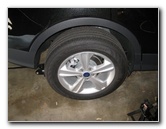
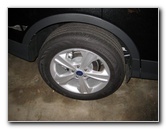
2015 Escape Rear Wheel
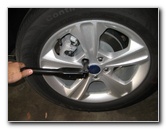
Slightly Loosen 5 Lug Nuts
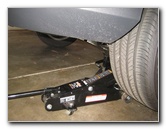
Raise Rear of Vehicle
Owners of other Ford or Lincoln vehicles such as the Focus, Fusion, C-Max, Mustang, Fiesta, Transit Connect, Edge, Flex, Explorer, Expedition, Taurus, F-150, EcoSport, MKC, MKZ, MKS, MKX, MKT and the Navigator may also find these DIY instructions to be helpful.
The items needed to complete this procedure include a lug nut wrench, a floor jack, two jack stands, a flat head screwdriver, a 7mm hex head socket with a ratchet or a 7mm Allen Key wrench, a disc brake piston tool set or a pair of needle nose pliers, and a tube of high temperature synthetic brake parts lubricant grease.
Please verify the correct replacement part numbers for your Escape by consulting with a Ford dealership's parts counter, an auto parts store or the Amazon Part Finder website. The compatible parts may vary depending on whether your SUV has 2WD (two wheel drive), 4WD (four wheel drive / 4 wheel drive), the model year and/or the trim level.
A few compatible replacement sets of new rear brake pads with their part numbers include the following: Wagner ThermoQuiet QC1564, ACDelco 17D1095CH, Akebono EUR1095, Dura International BP1095 C, StopTech 309.10950, Motorcraft BRF-13, Centric 105.10950, TRW TPC1564, Raybestos PGD1095C, ACDelco 14D1095CH, Power Stop 17-1095 Z17, Monroe DX1095 or CX1095.
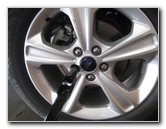
Spin Off 5 Lug Nuts
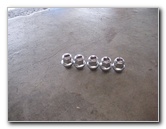
Five Lug Nuts Removed
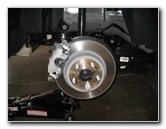
Caliper, Bracket, Rotor
If the emergency / parking brake is engaged, you won't be able to pull the rear caliper off the rotor.
Chock both sides of the front wheels to prevent the car from being moved while you are replacing the rear brake pads.
Slightly loosen the 5 lug nuts on the rear wheel by turning them counterclockwise about a 1/4 turn.
Carefully raise the rear of the vehicle and securely support it with at least two jack stands.
I prefer to work on one side of the vehicle at a time to keep three wheels on the ground for extra safety.
Spin off the five lug nuts in the counterclockwise direction and set them aside in a safe place.
Remove the rear wheel to reveal the caliper, bracket, rotor and suspension. Set the rear wheel aside in a safe place.
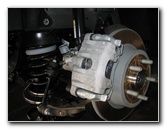
Rear Brake Caliper
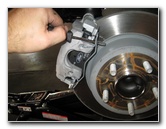
Carefully Pry Off Metal Clip
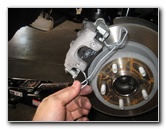
Spring Clip Removed
I would recommend wearing protective eye glasses just in case the metal spring clip flies off and hits you in the face.
Set the spring clip aside in a safe place.
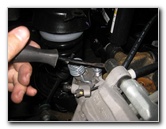
Pry Off Plastic Cap
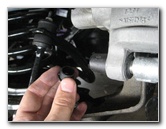
Bolt Cover Removed
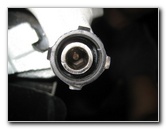
7mm Hex Caliper Bolt
Gently pry out the round black plastic dust caps to expose the caliper bolts.
Set the two caps aside in a safe place.
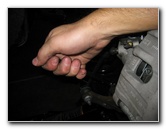
Loosen 7mm Clockwise
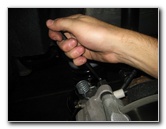
Loosen Top Bolt
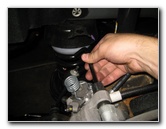
Spin Out Caliper Bolt
Then loosen the top 7mm hex head caliper bolt by turning it clockwise (as seen from the outside of the SUV).
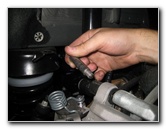
Top Caliper Bolt / Slider Pin
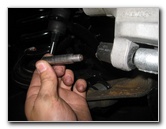
Lower Bolt / Pin Removed
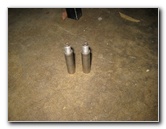
Two Caliper Bolts / Pins
The caliper bolts also act as the caliper slider pins or "guide pins".
Set the two combination caliper bolts and slider pins aside in a safe place.
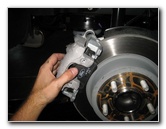
Pull Off Rear Caliper
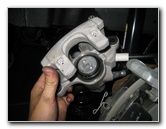
Screw In Type Caliper Piston
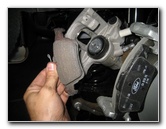
Remove Old Inner Pad
Rest the caliper on the suspension or suspend it from the spring with a bungee cord.
The third generation Ford Escape is equipped with screw-in type rear calipers that need to be turned back rather than "compressed" or "pushed" back like traditional caliper pistons.
Remove the old inner and outer brake pads from the bracket and discard them.
I've had great experiences with the Wagner ThermoQuiet QC1564 ceramic brake pads, and I really like how they don't require any backing plates, shims or disc brake quiet gel due to the built in insulators.
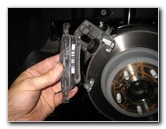
Pull Out Old Outer Pad
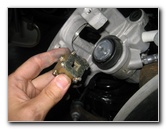
Lisle 28600 Piston Tool
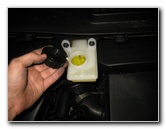
Twist Off Reservoir Cap
My usual go to tool which is the Lisle 28600 disc brake piston tool didn't seem to have a side that had a good grip on the caliper piston.
I was able to use a pair of needle nose pliers to turn back the piston. I'd recommend buying a disc brake piston tool set since I'm sure it would be easy than struggling with the needle nose pliers.
Before turning back the piston, move to the right rear area of the engine bay and twist off the brake fluid reservoir cap in the counterclockwise direction.
Removing the reservoir cap will allow the brake fluid to more easily travel back through the hose when you rotate back the piston.
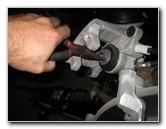
Turn Back Caliper Piston
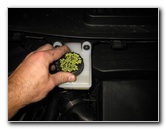
Replace Brake Fluid Cap
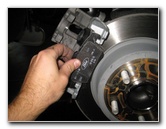
Install New Outer Pad
Or use a pair of needle nose pliers to carefully and slowly turn back the piston in the clockwise direction until it is flush with the rubber dust boot surrounding it.
Repeatedly check the brake fluid level in the reservoir while you are compressing the piston to make sure that it doesn't over flow.
Clean up any spilled brake fluid immediately and rinse the area with plenty of water. Brake fluid can easily damage painted surfaces.
Replace the brake fluid cap as soon as possible since brake fluid is hygroscopic (easily absorbs moisture from the air) by twisting it on in the clockwise direction.
Thoroughly clean off the brake rotor, caliper bracket, lug nut studs and the brake caliper assembly with brake parts cleaner spray. Do not use compressed air or blow with your mouth to clean off the brake parts since breathing in brake dust can be harmful to your health. Brake dust can be carcinogenic (cancer causing) if inhaled.
 If your Escape previously exhibited shuddering, pulsating, or vibrations in the rear end during braking, you may need to have your rotors "turned" (resurfaced) or just replace them with brand new rotors. If this is the SUV's first rear brake job and the rotors appear to be in excellent condition, you should be able to just change the pads with great results.
To remove the existing rotors and install new ones, remove the two bolts on the rear of the caliper bracket that attach it to the steering knuckle. Remove the bracket and set it aside in a safe place. Then loosen the old rotor with a rubber mallet, pull it off, and slide the new one in its place.
The 2013 to 2019 Ford Escape service manual specification for tightening the rear caliper bracket bolts (also known as the "brake caliper anchor plate" bolts) is 46 lb-ft (or 63 N-m) of torque.
Apply a thin layer of brake caliper grease to any area where there is metal to metal contact such as the outer lip of the caliper pistons. Do not apply brake parts lubricant to the friction surface of the new pads or to the rotor.
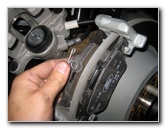
Insert New Inner Pad
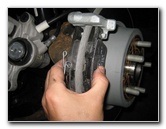
Push Pads Against Rotor
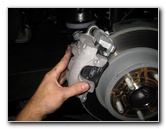
Lower Caliper Over Pads
Push the two pads together until they are flush against the rotor.
Carefully lower the caliper over the new pads and in to the bracket.
If the caliper won't fit over the thicker new brake pads, you may need to turn back the piston a bit further.
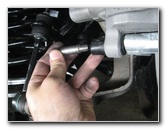
Lubricate Caliper Slider Pins
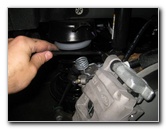
Tighten Counterclockwise
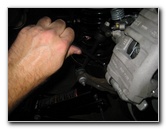
Tighten Lower Caliper Bolt
Do not apply grease to the threads on the caliper bolts.
Line up the bolt holes in the caliper with their corresponding holes in the bracket.
Spin in the two caliper bolts / slider pins a few turns by hand in the counterclockwise direction (as seen from the outside of the SUV) to prevent them from becoming cross threaded.
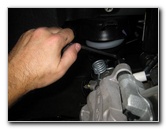
Torque To 20 ft-lbs
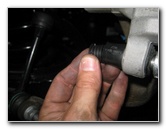
Pop In Bolt Caps
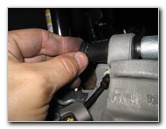
Push In Top Bolt Cover
Double check that both of the caliper bolts are tight before moving on to the next steps.
Push the round black plastic dust covers back in to place over the bolt housings.
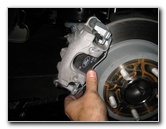
Re-Attach Metal Spring Clip
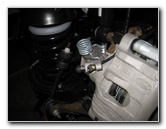
Rubber Valve Cap
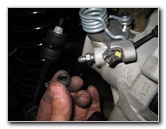
Brake Fluid Bleeder Valve
If your brake pedal previously felt soft or spongy, the brake fluid might be contaminated with water or the brake lines may contain some air bubbles.
It would be best to bleed the brake lines at this time in order to flush out the old fluid and replace it with fresh DOT 4 brake fluid. For more on this topic, check out my Brake Line Fluid Bleeding With An Assistant DIY Guide or alternatively the Brake Line Fluid Bleeding With A Power Bleeder Guide.
The brake fluid bleeder valve is located underneath a rubber cap on the back side of the caliper next to the upper caliper bolt.
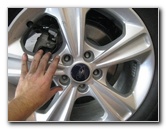
Push On Rear Wheel
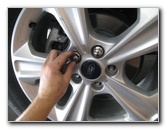
Spin On 5 Lug Nuts
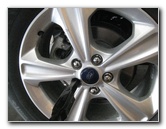
Turning Clockwise
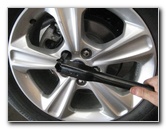
Lower Car From Stands
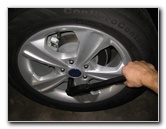
Torque To 100 ft-lbs
Rear Brake Pads Replaced
Carefully lower the SUV from the jack stands by using the floor jack.
Continue tightening the lug nuts in the clockwise direction in a "star" or "criss cross" pattern to about 1/4 to 1/3 turn past hand tight or about 100 lb-ft of torque as specified in the owner's manual.
It would be best to use a torque wrench or an impact wrench with a 100 lb-ft torque stick to properly tighten the lug nuts.
Sit in the driver's seat of the car and firmly press the brake pedal a few times to restore the brake line pressure. Check the brake fluid in the reservoir and verify that it is at the proper level. If it is low, add some fresh DOT 4 fluid.
To break in your new rear brake pads, just drive normally for the first few hundred miles while trying to avoid any hard or "panic" stops which may glaze over the new pads and cause them to be noisy and/or not perform as well.
It's also a good idea to regularly check your driveway for drops of brake fluid which may indicate a leak, check the brake fluid level in the reservoir, and also verify that the lug bolts are still tight. Be sure to record the rear brake pad change in your Escape's service records.
For more, check out my other 2013-2016 Ford Escape DIY Repair & Maintenance Guides.
2014 Ford Escape Caliper Piston Turn Back in
Source: https://paulstravelpictures.com/2013-2016-Ford-Escape-Rear-Disc-Brake-Pads-Replacement-Guide/index.html
0 Response to "2014 Ford Escape Caliper Piston Turn Back in"
Post a Comment